


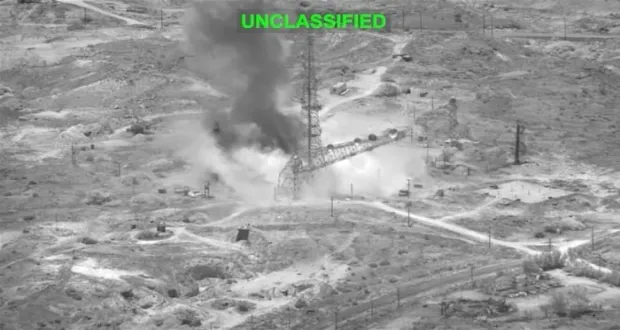
WEB DESK: The United States launched a new round of military strikes on Iran on Wednesday, targeting missile facilities, air defence systems, command centres and coastal military positions after reimposing a naval blockade around Iranian ports. In response, Iran said it attacked US military installations across the region, describing the conflict as an “existential war” with Washington.
The renewed fighting follows the collapse of a fragile ceasefire reached only days earlier, heightening fears of a broader regional conflict. Iran has again warned that regional energy exports could face disruption.
Tensions have escalated since Tehran announced the closure of the Strait of Hormuz on Saturday. Ongoing military activity has also severely affected shipping through the strategic waterway, which previously handled nearly 20% of global oil and gas trade. As uncertainty grew, Brent crude settled at a one-month high of $84.95 per barrel on Wednesday.
According to US Central Command, the first wave of strikes began around 6:00 a.m. EDT (1000 GMT), focusing on Iran’s coastal defence systems and cruise missile storage and launch facilities on Greater Tunb Island. A second wave followed roughly nine hours later, hitting military targets in several Iranian cities.
The US military said the attacks destroyed command centres, missile and drone capabilities, air defence positions and coastal surveillance facilities. It also confirmed strikes near Bandar Abbas, home to Iran’s largest commercial port and key naval and Revolutionary Guard installations overlooking the Strait of Hormuz.
Iran’s Islamic Revolutionary Guard Corps (IRGC) said it responded by launching missiles and drones at US military sites in Bahrain, Kuwait and Jordan. It claimed to have targeted a gathering of American troops and a radar installation at Kuwait’s Ali Al Salem Air Base.
US officials told Reuters the military campaign is aimed at weakening Iran’s military infrastructure before carrying out more complex operations to restore access through the Strait of Hormuz.
Separately, the US military said it disabled an oil tanker heading toward Iran’s Kharg Island after the vessel ignored repeated warnings. Officials said Hellfire missiles were fired into the ship’s smokestack. Since reinstating the naval blockade, the US says it has redirected two ships and disabled another.
Iranian media reported explosions in Bandar Abbas, Ahvaz, Konarak, Sirik and Qeshm, while additional blasts were reported near Khondab in central Iran. Authorities also activated air defence systems around Tehran in response to what officials described as hostile threats.
State broadcaster IRIB reported that a strike near a hospital in Ahvaz, which includes a pediatric cancer centre, forced a temporary evacuation. Families were seen gathering outside the hospital as emergency crews responded.
Following the initial attacks, senior Iranian official Mohammad Baqer Ghalibaf declared that Iran’s security depended on maintaining control of the Strait of Hormuz, adding that the country was engaged in an “essential and existential war” with the United States.
The conflict has already resulted in thousands of deaths and displaced millions across the region, particularly in Iran and Lebanon, where fighting involving Hezbollah has also intensified. Iranian media, citing the Health Ministry, reported that US strikes this month alone have killed at least 35 people.
US President Donald Trump expressed confidence that Iran would eventually seek an agreement, saying the country “wants to settle” and suggesting negotiations remained possible despite the ongoing military campaign.
Earlier this week, Trump said US officials had warned Tehran to reach a deal. Meanwhile, an Iranian military spokesperson maintained that reopening the Strait of Hormuz would require Washington to honour a 14-point memorandum of understanding signed between the two countries in June.
Amid the escalating conflict, there was one sign of diplomatic progress. Trump announced that Iran had released an American citizen who had been prevented from leaving the country since 2024. Human rights lawyer Jared Genser identified her as Dena Karari, confirming she was safely travelling back to the United States.
The post US carries out fresh strikes on Iran as Tehran retaliates against American bases appeared first on Karachi News.